
The Emerging AI-Native GTM Playbook: 6 Patterns from companies racing to $100M
What Lovable, Gamma, Mercor, Harvey, Genspark, Cluely and Surge AI have in common

👋 Welcome to AI-native GTM!
AI-native companies are re-writing the GTM playbook. Every other week, I will highlight the stories and frameworks behind some of today’s fastest growing startups. You can expect deep dives, analysis and insights to inspire the next generation of AI-native founders and operators.
The playbook for building billion-dollar AI companies looks radically different from the SaaS era. While traditional enterprise software companies spent years building sales teams and marketing engines, a new generation of AI-native startups is reaching massive scale with lean teams, minimal funding, and unconventional strategies.
Analyzing companies like Gamma ($50M+ ARR with 30 employees), Genspark ($36M ARR in 45 days), Surge AI ($1B ARR, bootstrapped), Mercor (now at $450M run rate), Lovable ($100M ARR in 8 months), Cluely ($6M ARR via controversy), and Harvey ($100M ARR in legal tech) reveals six emerging patterns in AI-Native go-to-market success. Note: you can read my deep-dives on each of these companies by clicking the links highlighted.
These outcomes aren’t statistical anomalies. They represent a fundamental shift in how AI-native companies acquire customers, generate revenue, and scale operations. This post explores six distinct patterns that separate explosive growth from incremental progress in the AI era.
Let’s dive in 👇
1. Momentum as a Moat: Distribution First
The traditional software development sequence—build product, achieve product-market fit, then scale distribution—has inverted for several AI companies. They’re deliberately building distribution capacity before fully validating product direction.
Genspark illustrates this approach clearly. The company initially positioned itself as an AI search engine, attracting 5 million users. But in late 2024, their team observed users evolving from information queries (”summarize this market”) to outcome-oriented commands (”create a pitch deck about this market”). Rather than perfecting their search product, they pivoted completely to an “AI Agentic Engine” in April 2025. This strategic redirection—away from search toward autonomous task execution—generated $36 million in ARR within 45 days.
The pivot succeeded because Genspark had already built distribution channels through their initial search product. When they shifted direction, those channels remained intact.
Cluely took an even more aggressive distribution-first stance. Co-founder Roy Lee weaponized his controversial personal history—being expelled from Harvard after a suspension led to mass-reporting, then kicked out of Columbia for creating Interview Coder, a tool explicitly designed to help users cheat on technical interviews—into the company’s core marketing narrative. The “cheat on everything” tagline wasn’t just provocation; it aligned authentically with Lee’s biography and generated continuous media attention.
Bryan Kim, partner at a16z and Cluely investor, described the underlying logic: in AI markets, “momentum as a moat” matters more than traditional defensibility. When foundational models improve monthly and competitors can replicate features quickly, velocity becomes the sustainable advantage.
The results validate the strategy. Lee stated directly: “The only reason I have the contracts that I do right now is because the decision makers at these enterprise companies have seen my Twitter and think I’m funny and are rooting for me.” Cluely converted social media attention into seven-figure enterprise contracts without building a traditional sales organization.
This distribution-first approach carries significant risks. Cluely’s provocative branding created tension with the trust required for a tool that accesses users’ screens and microphones. Early Reddit feedback suggests product quality initially lagged behind marketing hype. The company operates in what Lee himself described as a race to “hit escape velocity before pissing off too many people.”
Yet the pattern persists across multiple companies. Lovable’s open-source GPT-Engineer project attracted 52,000 GitHub stars before commercialization. When they launched the paid platform, that distribution channel converted rapidly—$10 million ARR in 60 days. The product improved iteratively while serving paying customers, rather than reaching perfection first.
The economic logic becomes clear when considering AI development cycles. Foundation models improve continuously. A large user base creates a compounding data advantage because every interaction generates training signals that continuously improve the underlying models. Features that took months to build can be replicated in weeks. In this environment, capturing user attention, scaling the install-base and iterating publicly may generate more defensibility than building in stealth.
2. Social Distribution as Core Infrastructure
The most visible commonality across these companies is their treatment of social platforms not as marketing channels but as foundational infrastructure for customer acquisition.
Genspark operates a network of more than 60 content creators—labeled internally as “interns”—who produce videos about the platform on a per-video compensation basis. Over a two-week period in early 2025, this network generated 20 million views across TikTok and Instagram. The strategy deliberately blurs boundaries between organic user content and paid promotion, creating what the company views as enhanced authenticity rather than diminished credibility.
The approach differs from traditional influencer marketing in scale and integration. These creators aren’t occasional brand ambassadors—they function as a distributed content production system that generates continuous algorithmic momentum. The volume of content creates an appearance of ubiquity that reinforces brand recognition and drives platform algorithms to amplify reach.
Cluely takes this concept further by making the founder himself the primary distribution channel. CEO Roy Lee has cultivated a deliberately provocative public persona, converting both praise and criticism into brand visibility. When he publicly announced plans to hire 50 interns solely to create TikTok content, or when San Francisco police shut down a company party, the resulting discourse generated awareness that traditional advertising couldn’t replicate.
The company’s hiring practices also reflect this strategic priority. Growth team positions require candidates to have a minimum of 100,000 followers on a major social platform, effectively making every hire a distribution node. This structural choice embeds virality into organizational design rather than treating it as a marketing function.
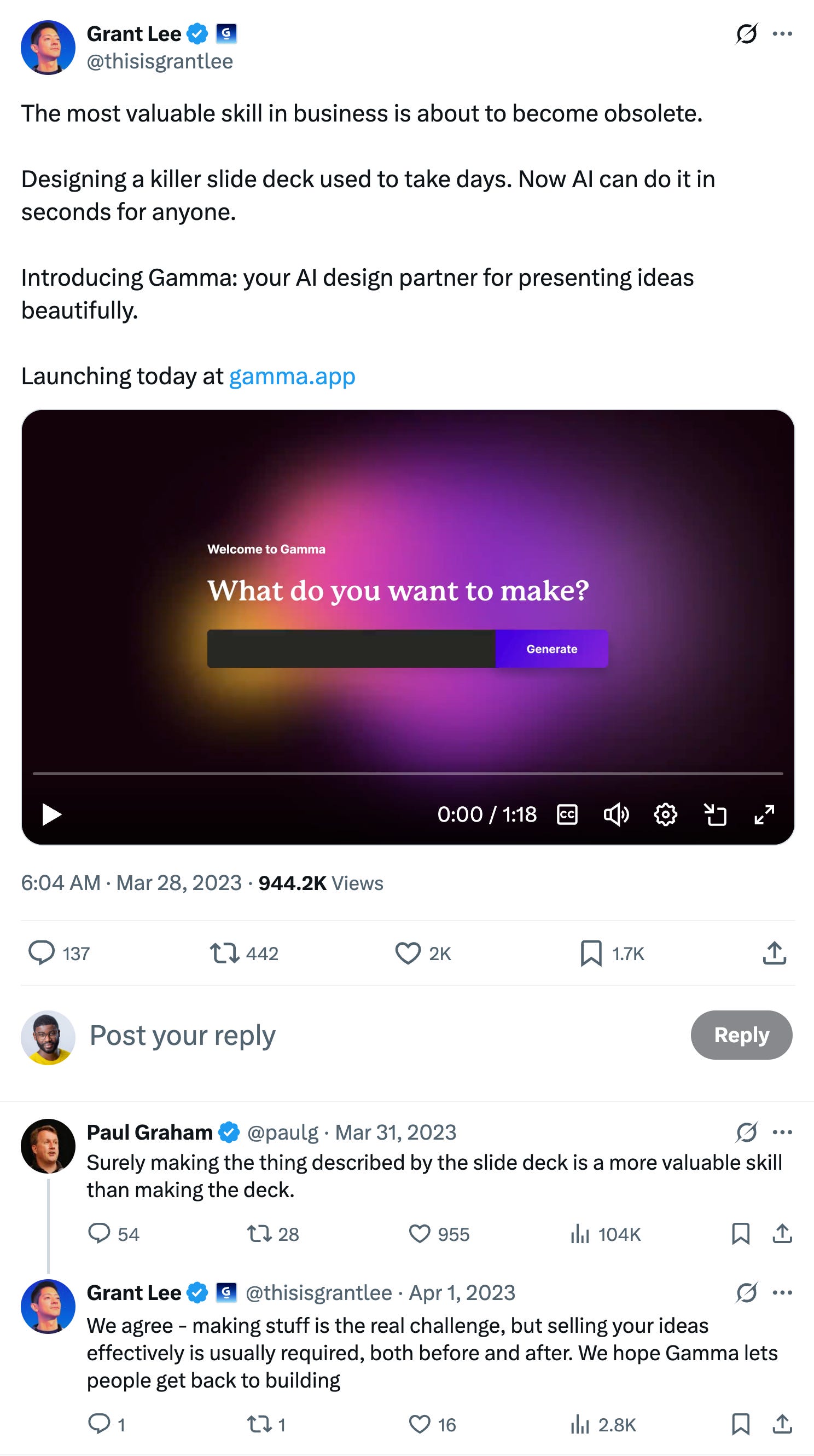
Gamma’s experience illustrates how founder-led social distribution can catalyze growth at critical moments. When CEO Grant Lee launched the AI-powered version of his product with a tweet designed to provoke reaction, the resulting controversy—amplified when figures like Paul Graham responded—triggered a viral loop that increased daily signups from thousands to tens of thousands within 72 hours.
What distinguishes this approach from conventional social media marketing is the architectural integration. These companies don’t run social campaigns—they’ve designed their organizations and go-to-market strategies around social platform dynamics from inception. The distribution model isn’t layered onto the business; it’s fundamental to how the business operates.
3. Products Engineered for Self-Distribution
A third pattern operates more subtly but with comparable impact: these companies design products whose core functionality inherently drives user acquisition.
Gamma’s approach makes this explicit. Every presentation, document, or website created on the free tier includes a “Made with Gamma” badge. This isn’t incidental branding—it’s a deliberate acquisition mechanism that functions as what product-led growth practitioners call a “casual contact loop.” The badge serves dual purposes: driving new user discovery while creating an upgrade incentive for users who want to remove it.
The product’s output formats amplify this effect. Presentations get shown to audiences. Documents get circulated among colleagues. Websites get published to the internet. Each piece of content functions as an advertisement, exposing Gamma to new potential users in the exact context where its value proposition is most relevant—when someone is viewing professional content and might need to create their own.
Lovable engineered similar mechanics through “Launched,” a showcase platform for applications built with Lovable. The platform gamifies creation by rewarding top projects with credits, while each showcased application includes an “Edit with Lovable” button that channels viewers directly into the product. The system creates what the company describes as a “template gallery on steroids”—simultaneously demonstrating product capabilities and driving acquisition.
The company replicated this pattern with “Linkable,” a tool for creating instant personal websites. A single tweet about the tool led to 20,000 websites created within one week, each displaying an option to “Edit with Lovable.” This represents what might be called meta-growth: using your own product to build distribution tools, creating a virtuous cycle where the marketing asset also serves as a product demonstration.
Mercor’s approach differs in mechanism but follows the same principle. As an AI-powered talent marketplace, every successful placement generates performance data that improves the matching algorithm’s accuracy. This creates a data flywheel where more placements lead to better predictions, which lead to higher quality matches, which lead to more placements. The product becomes more valuable and defensible with each transaction—a moat that compounds automatically through usage rather than through deliberate marketing investment.
The strategic insight connecting these examples: distribution isn’t something added to a product through marketing—it’s an architectural decision made during product design. The most effective distribution strategies are those where product usage itself generates new user acquisition.

4. Doing the Hard Thing First: Strategic Wedge Selection
Conventional enterprise software strategy emphasizes identifying a simple use-case with an Ideal Customer Profile that’s easier to sell to and focusing efforts accordingly. The AI-native approach inverts this: several companies deliberately chose initial customer segments not because they were easiest to sell to, but because they would force the fastest product learning.
Mercor’s selection of AI labs as their wedge customer exemplifies this strategy. The company could have pursued traditional enterprise hiring, which offered larger total addressable markets. But AI labs provided asymmetric strategic advantages.
First, feedback loops operated on dramatically different timescales. When Mercor placed contractors with AI labs, performance data returned within days rather than months. This allowed rapid iteration on their candidate assessment models. Second, AI labs’ demands forced automation. When OpenAI or Anthropic requested 300 qualified data labelers within 48 hours, manual recruiting processes couldn’t scale. This “unreasonable ask” compelled Mercor to build genuine AI-powered vetting rather than human-intensive screening.
Third, the customer segment positioned Mercor at the intersection of two valuable markets. Adarsh Hiremath, Mercor’s CTO, noted that “human data and talent assessment have actually become the same thing.” By framing their service for AI labs’ data annotation needs, they built capabilities applicable to any knowledge work hiring—effectively solving a narrow problem while developing broadly applicable technology.
Harvey made a similar calculation in legal technology. Law firms represent notoriously difficult customers: conservative, risk-averse, and protective of client data. Yet Harvey chose this challenging segment deliberately. The demands forced them to build deep domain expertise, develop rigorous security frameworks, and create trust mechanisms that became defensible advantages.
Instead of trying to scale quickly across many smaller customers, the company also focused obsessively on winning over a select few of the world’s most prestigious law firms. Allen & Overy (now A&O Shearman) became Harvey’s watershed moment. The global law firm conducted an extensive trial where 3,500 attorneys asked 40,000 questions before committing to a broader rollout. This wasn’t just a customer win—it was a signal to other leading law firms that AI had arrived.
When competitors eventually replicated Harvey’s AI capabilities, the legal workflows, firm relationships, and compliance infrastructure remained differentiated. The difficult customer segment had forced them to build moats that easy customers wouldn’t have required.
Surge AI also leveraged AI labs as initial customers, using their rapid feedback cycles to accelerate the company’s data quality flywheel, and building an exceptionally powerful word-of-mouth growth engine with technical buyers. They chose to focus on complex data problems as a deliberate strategy: rather than hiring generalist workers to create training examples, Surge AI sources domain experts—PhD physicists for physics problems, accomplished writers for creative tasks, experienced programmers for coding challenges. This ensures that AI models learn from demonstrations of genuine expertise rather than amateur approximations. Surge AI also built sophisticated machine learning systems that analyze multiple signals from annotators’ work, activity, and performance patterns.
The strategic insight: early customer selection should optimize for learning velocity rather than sales efficiency. Customers who demand rapid iteration, expose the product to diverse use cases, and force automation of manual processes provide more long-term value than those who accept minimum viable products without pressure to improve. These customers generally also have more complex data needs that in the long term create more powerful AI applications and product stickiness.

5. Credit-Based Pricing Aligned with AI Economics
Traditional SaaS pricing models—fixed-tier subscriptions typically based on seat count—prove inadequate for AI products where value delivery varies dramatically based on usage intensity and computational requirements. The companies achieving rapid growth are starting to converge on credit-based systems that align pricing more closely with actual value consumption and infrastructure costs.
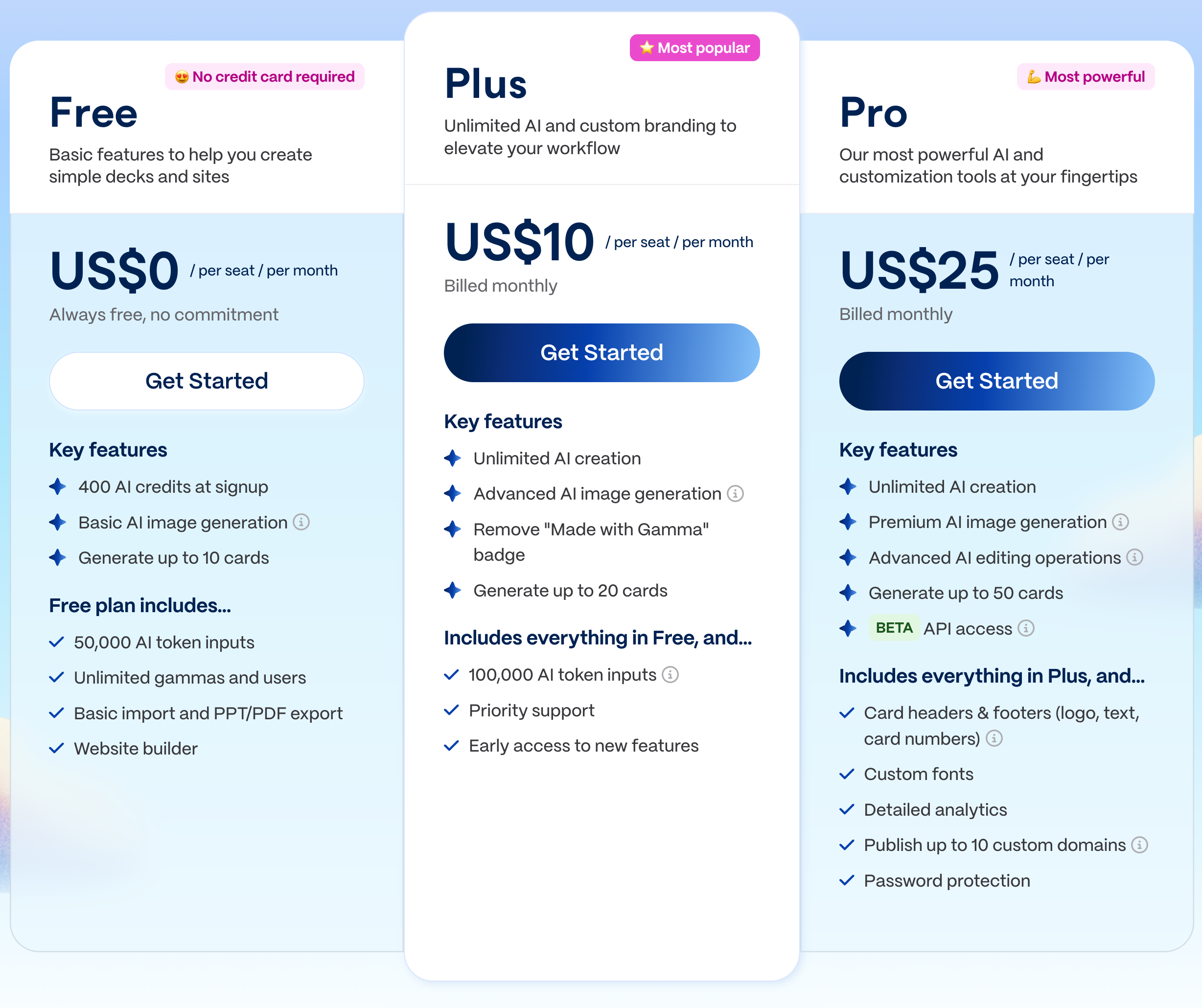
Gamma’s pricing evolution is instructive. The company launched AI features without payment infrastructure, implementing credit limits solely to manage compute costs. User response was immediate: support channels flooded with requests to purchase additional credits. Monetization became not a go-to-market strategy but a demanded feature. The resulting model offers 400 free credits, then $10 monthly for 400 credits or $20 monthly for unlimited usage. Notably, company leadership stated they’re “comfortable losing money on power users” because these high-engagement users drive the viral loops that generate new customers.
Genspark employs a more granular approach, varying credit costs based on computational requirements. Simple chat queries consume minimal credits, while generating video content with premium models like Google’s Veo may cost 1,000-2,000 credits. The free tier provides 200 daily credits, with paid plans at $25 monthly (Plus) or $249 monthly (Pro, offering 125,000 monthly credits).
Lovable structures pricing around message limits rather than generic credits, with the $20 Starter plan providing approximately 250 messages monthly and the $100 Scale plan offering five times that capacity. Unused messages don’t carry forward, creating clear upgrade triggers when users approach limits.
Mercor takes a different approach, operating a marketplace model that charges companies a 30% fee on top of talent compensation while offering candidates free access to valuable tools like mock interviews and resume feedback. This asymmetric pricing strategy—monetizing demand while subsidizing supply—addresses the classic marketplace cold start problem by building a large, engaged candidate pool independent of immediate hiring demand.
These pricing structures accomplish three objectives: they control variable AI costs directly tied to usage, create natural conversion moments when users exhaust free allocations, and align revenue with delivered value rather than arbitrary seat counts.
6. Capital Efficiency as Strategic Discipline
The final and perhaps the most striking pattern: these companies achieve hypergrowth with remarkably lean operations, challenging conventional venture capital wisdom about the relationship between capital deployment and growth velocity.
Surge AI reached $1 billion in ARR with approximately 110 employees—roughly $9.1 million per person. Their primary competitor, Scale AI, generated approximately $870 million with over 1,000 employees—about $870,000 per person. The 10x difference in leverage stems from Edwin Chen’s explicit philosophy: “Hire 10x people, not 10x more people.”
This wasn’t merely aspirational rhetoric. Chen operates on the belief that in most large technology companies, 20% of employees drive 80% of impact. His hiring strategy focuses exclusively on recruiting that top quintile. The operational model assumes most team members should be active individual contributors (”doers”) rather than managers building organizational hierarchies.
Gamma implemented a related approach through their “player-coach” model. Leadership roles combine management with significant individual contribution. Leaders spend substantial time coding, designing, or directly building product rather than exclusively managing teams. At one stage, designers constituted one-third of Gamma’s team (4 of 12 employees), an unusually high ratio reflecting their conviction that user experience provides the primary differentiation in AI applications.
The player-coach structure serves multiple functions. It keeps the management layer lean, limiting organizational overhead. More importantly, it forces hiring of high-agency individuals capable of operating autonomously. Because player-coaches have limited time for traditional management, they cannot micromanage. This necessity creates a culture where individual contributors must make decisions independently and execute without extensive oversight.
Genspark achieved extreme leverage through a hybrid model: an 11-person core team (4 engineers, 7 growth roles) augmented by 60-70 contract UGC creators. The contractors operated on a per-video payment model, generating massive content volume (20 million views in two weeks) without the overhead of traditional employees. This structure allowed Genspark to scale content production independently of headcount growth.
Lovable maintained extraordinary discipline throughout their scaling. They reached $50 million ARR with fewer than 30 employees—over $1 million ARR per person, roughly 5x the benchmark considered “good” for software companies in their revenue range. The company explicitly rejected Y Combinator to avoid potential distraction, burnt only $2 million to reach $30 million ARR, and maintained a hiring mantra of “painfully slow” to preserve talent bar and cultural coherence.
These structural choices create compounding advantages from three operational choices: hiring for breadth and depth simultaneously, a relentless focus on product quality over organizational complexity and automation-first operations. Lean teams move faster because they have fewer coordination costs. High-agency individuals require less management oversight, allowing leadership to remain focused on strategy and product. The resulting velocity often matters more than raw feature development capacity.
What This Means for Founders
These patterns illuminate a distinct playbook for AI-native companies, but they also reveal important tensions and strategic trade-offs that founders must navigate.
On social distribution: Building virality into go-to-market from inception proves powerful, but it requires authentic alignment between founder persona and product positioning. Roy Lee’s provocative approach works for Cluely because the product explicitly offers users a “covert advantage”—the brand and product messaging form a coherent whole. Forced or manufactured authenticity typically fails. The critical question: Does your personal story or your product’s inherent use case naturally support viral, controversial, or highly shareable positioning?
On product virality: Designing products that distribute themselves requires subordinating some product decisions to growth mechanics. Gamma’s “Made with Gamma” badge and Lovable’s “Edit with Lovable” buttons are growth features presented as product features. This demands treating virality as a first-class product requirement from inception, not as a post-launch addition. The challenge: balancing growth optimization with user experience, particularly when viral mechanics might create friction or limit functionality.
On credit-based pricing: The model aligns with AI infrastructure economics but introduces complexity that can damage user experience. It works best when the product reliably delivers value, but becomes punitive when outputs fail. The strategic challenge: maintaining the psychological scarcity that drives conversion while avoiding user alienation from wasted credits. Potential solutions include credit refunds for failed tasks, unlimited usage for certain core features, or hybrid models combining base subscriptions with usage tiers. No perfect solution has emerged yet.
On strategic customer selection: Building AI-native companies requires choosing initial customers for their capacity to accelerate learning rather than their willingness to buy. This creates a fundamental tension: the customers who force fastest learning are often hardest to close, creating extended sales cycles exactly when startups are most resource-constrained. The strategic wager: that capabilities forged under extreme demands create defensible advantages that remain valuable as companies expand to easier segments. The core trade-off is between near-term revenue efficiency and long-term competitive moats, with founders betting that products hardened by difficult customers will dominate markets that competitors entered through easier paths.
On capital efficiency: Remaining lean enforces discipline and preserves strategic optionality, but may limit velocity in winner-take-all markets. Surge AI’s bootstrapped path succeeded because they targeted a concentrated customer base (elite AI research labs) with high willingness to pay. Lovable’s lean approach worked because their product-led growth motion proved highly efficient. However, in markets requiring significant infrastructure investment or facing well-funded competitors, extreme capital efficiency may not be viable. The question isn’t whether to raise capital but when and how much.
The deeper insight from these seven companies isn’t that one playbook fits all circumstances. Rather, the AI era demands questioning foundational assumptions about go-to-market strategy. Distribution can emerge from product architecture rather than from sales organizations. Pricing can be dynamic and usage-based rather than fixed and seat-based. Growth can be viral and organic rather than paid and programmatic. And profitability can coexist with hypergrowth rather than being delayed until after market dominance is achieved.
The companies succeeding in this environment aren’t those executing traditional playbooks with greater efficiency—they’re those writing entirely new playbooks suited to the unique economics, capabilities, and dynamics of AI-native businesses. As the market matures, these early patterns will likely evolve. But for now, they offer a roadmap for founders building in an era where the rules are still being written.
Great Read!! As the cost of compute continues to drop and new technologies make it easy for competitors to copy software, traditional advantages like having a unique product or strong technical barriers are less effective. While having strong distribution and getting your product into the hands of customers through effective channels is more important than ever!
Interesting read