
From Zero to $100M ARR in 11 Months: The Mercor Story
How Three College Dropouts Built Silicon Valley's Fastest-Growing Talent Marketplace Without a Sales Team

👋 Welcome to AI-native GTM!
AI-native companies are re-writing the GTM playbook. Every other week, I will highlight the stories and frameworks behind some of today’s fastest growing startups. You can expect deep dives, analysis and insights to inspire the next generation of AI-native founders and operators.
Today, we take a look at Mercor.

Year Founded: 2023
Headquarters: San Francisco, CA
Total Funding: $133M
Founders: Brendan Foody, Adarsh Hiremath, Surya Midha
Let’s dive in 👇
The Audacious Vision
In a cramped San Francisco office, three 20-year-old college dropouts are quietly building what they believe will become "the largest opportunity in the economy." Their company, Mercor AI, has a simple yet ambitious goal: collect data on everyone on Earth and match them with the perfect job opportunities using artificial intelligence.
It may seem like a vision not rooted in reality, but the numbers are very real. In just 11 months, Mercor went from zero to $100 million in annual recurring revenue. They've raised $133 million across three funding rounds, reaching a $2 billion valuation. Their AI has conducted over 100,000 interviews and helped place thousands of workers at nearly every major AI lab and tech company.
The founders—Brendan Foody (CEO), Adarsh Hiremath (CTO), and Surya Midha (COO)—aren't your typical Silicon Valley entrepreneurs. They're Harvard and Georgetown dropouts who bonded over high school debate competitions, where Hiremath and Midha formed what's been called "the winningest debate team of all time." Their shared experience of rapid-fire analysis and performing under pressure would prove invaluable in building one of the fastest-growing talent marketplace ever built.

The Problem They're Solving
Mercor's founders believe that the global hiring system is fundamentally broken. Two major inefficiencies plague the $200 billion recruitment industry:
Fragmentation: Job seekers typically apply to only a handful of positions, while companies review just a tiny fraction of available talent. It's a matching problem at massive scale, where the best candidates and best opportunities rarely find each other.
Imperfect Information: Even when matches occur, predicting who will succeed in a role remains largely guesswork. Traditional interviews capture only a snapshot of capability, often missing the nuanced skills that determine real-world performance.
These problems existed long before AI, but the founders argue that recent breakthroughs in large language models have finally made automation possible at the sophistication level hiring requires. "The concept of an AI agent conducting sophisticated interviews was completely implausible just two years ago," Foody explains.
From Zero to $100 Million: The Growth Story
Mercor's growth trajectory reads like a startup fairy tale, but the path was anything but accidental. The company's revenue milestones tell the story:
Year One: Mid-seven figures in revenue, entirely bootstrapped through referrals
November 2024: $50 million ARR
February 2025: $75 million ARR
March 2025: $100 million ARR
This represents 6,400% year-over-year growth and sustained 41-50% month-over-month expansion—numbers that would be impressive for any company, let alone one run by people barely old enough to drink.
The funding followed the growth, not the other way around. Mercor raised over $3 million in seed funding led by General Catalyst, followed by a $30 million Series A from Benchmark at a $250 million valuation. Their recent $100 million Series B, led by Felicis with participation from General Catalyst and Benchmark, valued the company at $2 billion.
What makes these numbers even more remarkable is the team size. When Mercor hit $50 million ARR, they had just 30 full-time employees in the US, plus about 20 contractors in India. That's roughly $1.7 million in revenue per US employee—efficiency that would make even the most seasoned venture capitalists take notice.
The Origin Story: Solving Their Own Problem
Like many successful startups, Mercor began with the founders scratching their own itch. Initially, the three were running a development shop, building software for other companies while recruiting engineers from India's prestigious Indian Institutes of Technology (IITs) to support their projects.
"We became very obsessed with this idea of the inefficiencies around doing this [hiring]," Foody recalls. They recognized the exceptional quality of talent they were working with, but also saw how cumbersome and time-consuming it was to find and vet these individuals properly.
The breakthrough came when they realized they could automate much of this process. In summer 2023, all three dropped out of their respective colleges to focus full-time on what would become Mercor.
Their early traction was entirely organic. Through word-of-mouth referrals alone, they scaled to a low seven-figure run rate before raising any external capital. This bootstrapped growth proved two crucial things: there was genuine demand for their solution, and their product delivered real value from day one.
The AI Labs Strategy: The Wedge to Market Entry
One of Mercor's most strategic decisions was choosing AI laboratories as their initial customer base. This wasn't obvious—AI labs represent a relatively small market compared to general corporate hiring. But the choice proved brilliant for several reasons.
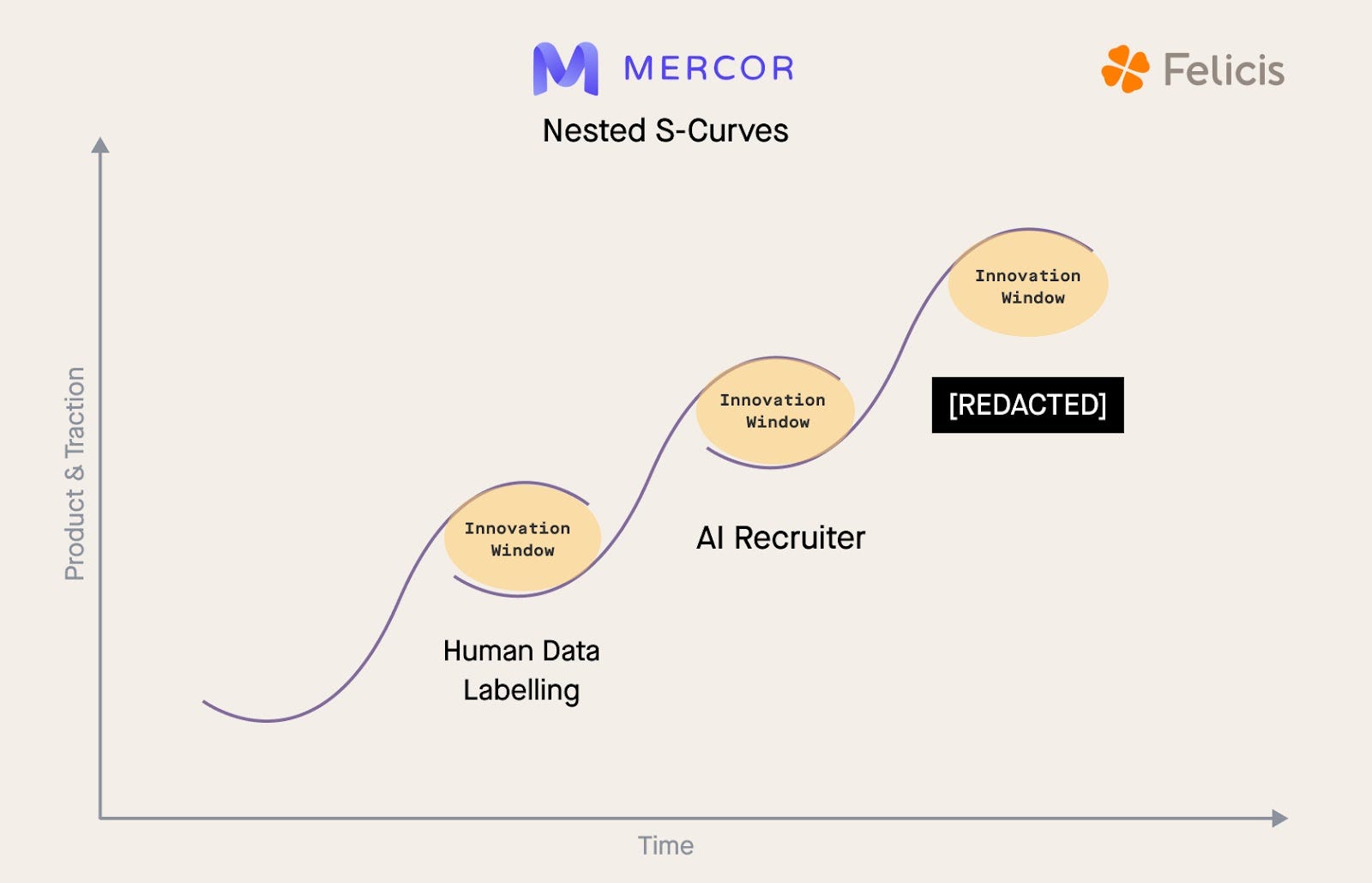
AI labs have an urgent, specific need: finding human experts to help train and refine their models. As AI systems become more sophisticated, they require human feedback from domain experts across fields like law, medicine, finance, and engineering. This "human data" collection has evolved from simple crowdsourced labeling to sophisticated expert assessment—essentially a high-stakes talent acquisition challenge.
"Human data and talent assessment have actually become the same thing," Hiremath explains. By reframing AI labs' data needs as a hiring problem, Mercor positioned itself at the intersection of two booming markets.
The AI labs also provided something invaluable: rapid feedback loops. Traditional enterprise hiring might take months to determine if a placement was successful. AI labs often knew within days whether someone was performing well, giving Mercor's algorithms crucial performance data to improve their models quickly.
Perhaps most importantly, these labs made "unreasonable asks"—like needing 300 qualified experts in two days. Meeting these demands forced Mercor to automate aggressively and build robust systems that could handle scale. It was trial by fire that hardened their platform for broader market expansion.
The Product: AI Recruiting Built Different
At its core, Mercor operates two interconnected platforms. Candidates use work.mercor.com to upload resumes, participate in AI interviews, and get matched with opportunities. Employers use team.mercor.com to define roles, search for talent, and review detailed candidate profiles.
The standout feature is their AI interviewer, which they've named "John Sharma." This isn't a simple chatbot asking scripted questions. The AI reviews candidates' resumes, GitHub repositories, and personal websites before crafting personalized, in-depth interviews.
For example, if a software engineer has built a distributed database system, the AI might ask about specific architectural decisions, scalability trade-offs, or why they chose particular technologies. If a designer has a portfolio website, it might inquire about their design process or the reasoning behind specific visual choices.
"It's often far better than a human interview," Foody claims, "because it can do extensive pre-processing that humans simply don't have time for."
The AI's assessments go beyond conversation. Mercor's models analyze multimodal data including GitHub activity, interview performance, and even subtle cues like video quality or vocal tone. They're exploring cutting-edge techniques like predicting engagement levels from facial expressions during interviews.
All of this feeds into what Mercor calls their "data flywheel." Every successful (or unsuccessful) placement provides performance feedback that improves their prediction models. The more people they place, the better they become at identifying who will succeed in specific roles.
The Business Model: Marketplace Economics
Mercor operates as a marketplace, connecting companies with talent while taking a cut of each transaction. They typically charge employers around 30% of a contractor's pay rate, though this varies based on the client and complexity of the placement.
"The only way Mercor makes money is by giving people jobs," the company states, emphasizing their alignment with positive outcomes.
This fee structure works because Mercor can deliver value that justifies the cost. By automating expensive, time-intensive processes like candidate sourcing and vetting, they can offer better results faster than traditional recruiters. As Foody puts it: "If we're able to find those 0.1% people reliably at the cost of software, what we take is often a second thought."
For candidates, the platform is largely free. They get access to AI-powered mock interviews, resume feedback, and career advice—tools that help build Mercor's talent supply while providing genuine value to job seekers.
The company also handles payment processing and international compliance, giving them visibility into the complete transaction lifecycle. This data—how long contractors work, their performance ratings, project extensions or terminations—feeds directly back into their AI models.
Growing Without Traditional Sales and Marketing
Perhaps most remarkably, Mercor has achieved massive scale without a traditional sales team. "We don't have a sales team. There isn't a single person who works on sales at Mercor outside of the founders," Hiremath explains.
Instead, they've built a product-led growth engine powered by several key strategies:
For Candidates (Supply Side):
Free AI tools like mock interviews and resume feedback
Referral programs asking successful hires to recommend talented friends
Direct outreach to coding communities at top universities
Building a "Talent Cloud" by analyzing GitHub profiles and other public data
For Employers (Demand Side):
Word-of-mouth referrals from satisfied customers
Inbound interest driven by reputation and results
Planned content marketing using AI to generate thousands of targeted blog posts
Community engagement in founder networks
The key conversion moment for employers typically happens "when the first couple candidates start working with them." The quality of Mercor's placements becomes the primary sales tool.
Looking ahead, the company plans to invest heavily in AI-generated content marketing, using GPT to create thousands of niche blog posts targeting specific hiring needs—like "how to hire GIS engineers internationally." This approach could capture high-intent searches at scale while maintaining their lean operational structure.
The Culture Factor
Mercor's internal culture deserves special attention because it's become a crucial part of their competitive advantage. The company operates on what they call a "996" schedule—9 a.m. to 9 p.m., six days a week—with all US employees working in-person in San Francisco.
This "maniacally intense, hardworking culture" isn't just about long hours. It's about attracting people who are "bought into the mission" and thrive in high-stakes environments. The skills the founders developed in competitive debate—rapid analysis, performing under pressure, articulating complex arguments clearly—permeate the company culture.
This intensity has practical benefits. It allows them to respond to client demands with exceptional speed, often turning around complex hiring requests in days rather than weeks. It also helps them attract both employees and clients who value this level of commitment and execution.
Challenges on the Horizon
Despite their impressive trajectory, Mercor faces several significant challenges as they scale:
Big Tech Competition: While Mercor currently views LinkedIn critically, the threat of major technology companies leveraging their resources and data to enhance AI-driven recruiting capabilities remains real.
Ethical AI Concerns: As AI plays a larger role in hiring decisions, scrutiny around algorithmic bias, fairness, and transparency will intensify. Mercor must proactively address these concerns while maintaining their competitive edge.
Enterprise Sales Evolution: Their current "no sales team" model works well for product-led growth and inbound leads, but penetrating large enterprise accounts typically requires dedicated sales teams and longer relationship-building cycles.
Quality at Scale: As volume grows exponentially, maintaining consistent quality in vetting and matching while keeping both employers and candidates satisfied becomes increasingly complex.
The Road Ahead: Lessons for Founders
Mercor's journey offers several actionable insights for founders building in competitive, technology-driven markets:
1. Solve Your Own Problem First: The most compelling products often emerge from founders' direct experiences with market inefficiencies. Mercor's early organic growth stemmed from solving a problem they intimately understood.
2. Choose Your First Customers Strategically: AI labs provided rapid feedback, sophisticated demands, and credibility within the tech ecosystem. The right early customers can accelerate product development and market validation simultaneously.
3. Build Network Effects into Your Business Model: Mercor benefits from both traditional marketplace effects (more candidates attract more companies) and a data flywheel effect (more placements improve AI performance for everyone).
4. Demonstrate, Don't Just Describe: Instead of making claims about AI capabilities, Mercor shows clients actual interview recordings and explains their selection rationale. In an era of "AI washing," transparency builds trust.
5. Focus on Value Creation Over Traditional Metrics: Mercor achieved massive revenue without dedicated sales and marketing teams by creating genuine value for both sides of their marketplace.
The Bigger Picture
Mercor represents more than just another successful startup—it's a glimpse into how AI might reshape fundamental economic systems. Their vision of creating a "global, unified labor market" where talent and opportunities find each other efficiently could have profound implications for how we think about work, careers, and economic opportunity.
Whether they'll achieve this ambitious vision remains to be seen. But their rapid growth suggests they've identified something real: a way to use AI not just to automate existing processes, but to fundamentally reimagine how human talent gets discovered, evaluated, and deployed in the modern economy.
For now, three former debate champions are working 12-hour days in San Francisco, building the infrastructure for what they believe will be the world's most important marketplace. The next few years will determine whether their audacious vision becomes reality—or just another Silicon Valley dream that grew too big too fast.
This analysis is based on public information, interviews, and company materials as of August 8, 2025. Some details may have changed since publication.